
The Concepts of Command-Based Programming
What is Command-Based Programming?
Section titled “What is Command-Based Programming?”Up until now, most of the code you’ve written has been akin to a set of instructions (execute this task, then this, and finally this). However, robots (and humans!) don’t just execute a set of tasks and shut down.
Imagine your daily routine. When an alarm clock rings, you turn it off and tumble out of bed. When your belly rumbles, you walk to the fridge and get a snack. When the clock strikes 8 AM, you open the front door to leave for school.
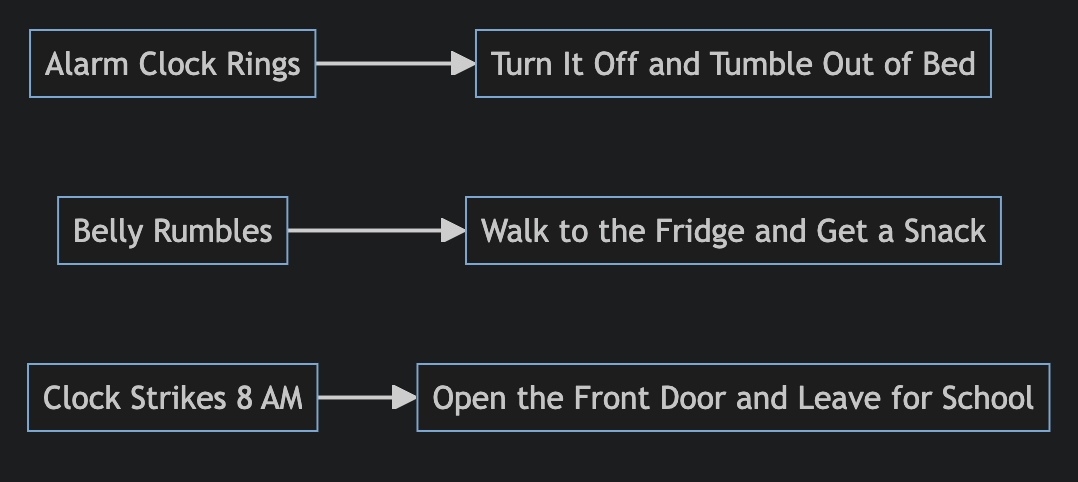
Notice how none of these actions had a predefined order; rather, they were a reaction to to certain kinds of stimuli.
Command-based programming models robot behavior in a similar way.
- It defines behaviors/actions(tumbling out of bed, getting a snack, etc.) as
Commands. - It defines the stimuli that trigger these behaviors (a ringing alarm clock, a rumbling belly, etc.) as
Triggers.
For instance, a command-based robot might have the following structure:
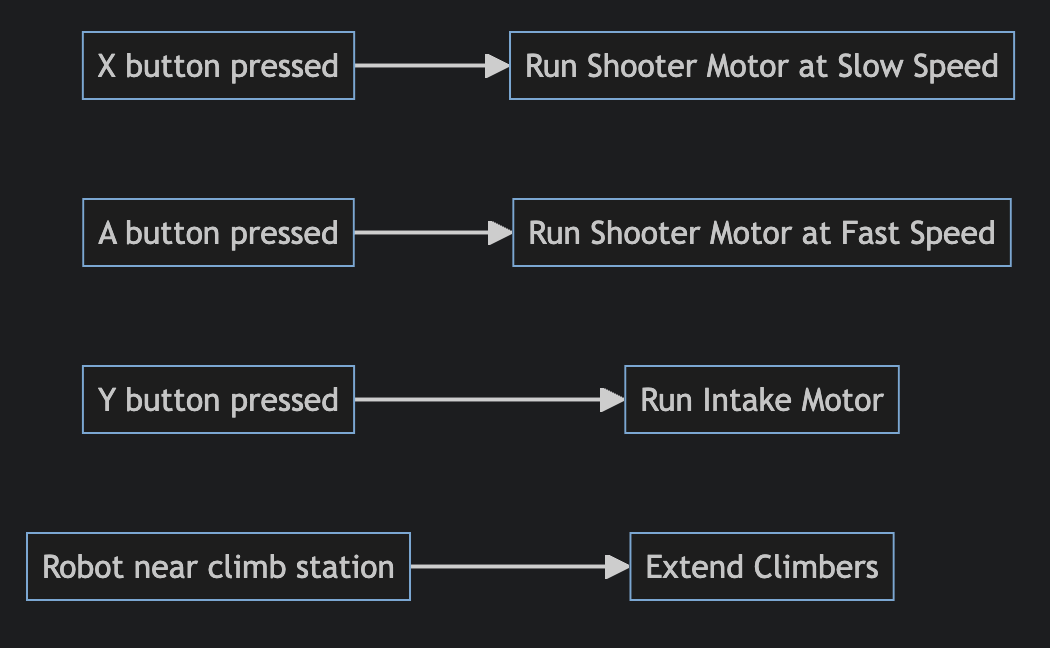
Here, everything on the left is a Trigger, while everything on the right is a Command.
We say that triggers “schedule” commands. So, the “y button pressed” trigger would schedule the “Run Intake Motor” command. In a similar way, commands are “bound” to triggers.
Mechanisms and Priority
Section titled “Mechanisms and Priority”However, the structure of using Commands to represent behaviors misses an important component.
Think back to the human example: you’re walking to the fridge, but the clock hits 8 AM before you get there. You can’t do both at once, since both actions require your arms and legs. So, you stop and leave for school.
Next, the robot. If the X and Y buttons are held, the shooter and intake motors should both run. But if the X and A buttons are held, the robot code must choose between running the shooter at a fast speed or a slow speed.
Command-Based models this relationship with 2 concepts: Mechansisms and Priority.
Mechanisms
Section titled “Mechanisms”A Mechanism is a robot component whose state can be updated through commands.
Commands declare
the mechanisms they require - thus, mechanisms are also called “requirements”.
An intake is a mechanism because your code controls its speed. On the other hand, an apriltag camera wouldn’t be because your code only reads data from it, but doesn’t update its state.
In the human case, your arms and legs would be mechanisms, but your ears wouldn’t be.
Priority
Section titled “Priority”When 2 commands share one or more requirements, priority determines which command should be cancelled and which command should continue.
In the human example, the “leave for school” Command would have a higher priority
than the “get a snack” Command.
Priority is represented as an int.
Commands default to a priority of 0, and a
larger number represents a higher priority.